C++ Is a Compiled Language
To run programs written by developers, the source code must go through two processing stages. The code you write is only character text, which computers cannot understand. A compiler converts these text symbols into various instructions readable by the CPU, namely machine language — the only set of commands a CPU can execute line by line.
- Compilation: The compiler reads source files and generates object files;
- Linking: The linker combines multiple object files to produce an executable program.
A C++ project usually consists of multiple source files. Below is a schematic diagram of the workflow:
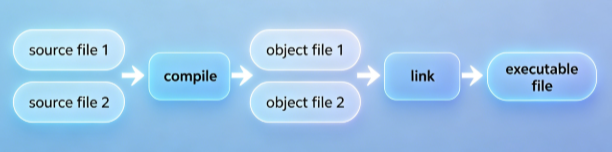
The generated executable file is bound to specific hardware and operating systems and cannot run cross-platform directly (a Mac program cannot be launched directly on a Windows PC).
The so-called portability of C++ refers to the portability of source code: the same set of source files can be compiled separately on different systems and run normally.
In other words, the EXE compiled on Windows cannot be copied and run on Mac. Instead, the identical source text (files ending with .cpp and .h) is copied to Mac, then compiled via Mac’s C++ compiler into a Mac-compatible executable.
ISO C++ Standards
The ISO C++ standard defines two major components
- Core Language Features: Built-in fundamental capabilities of the language itself, such as primitive types
char/int,for/whileloops, etc. - Standard Library Components: Official bundled toolset, including containers like
vector/map, output with<<, input reading viagetline()and other I/O operations.
The entire standard library is implemented in pure C++ code and built into all major compilers; only a tiny number of low-level scenarios (such as thread context switching) rely on a small amount of machine code.
Why do we need the standard library? The standard library is similar to the SDK we often mention. Its purpose is to reduce development workload for C++ programmers. If developers had to implement every basic function from scratch, few people would use this language. For example, printing a line of text to the console would require massive repeated work if every coder wrote the logic independently. To solve this problem, C++ designers pre-wrote a full set of code, compiled it into libraries (.lib), and provided them for developers to reuse. Simply put, it avoids reinventing the wheel, drastically boosts development efficiency, and attracts more users.
The standard library does not rely on obscure special syntax. It is written purely in C++, so you can fully read its source code and customize similar tools by yourself.
C++ Is a Statically Typed Language
For all variables, values, identifiers and expressions, the compiler must clearly know their types at the position where they are used in code. An object’s type directly determines which operations it supports.
Core Advantages of Static Typing: Type checking is performed during compilation. Many errors are caught by the compiler while coding instead of crashing after program launch, balancing security and performance. To elaborate: when the compiler translates your code into machine language, it will throw errors if mismatched types are detected. For instance, storing a name string inside an integer variable meant for age will trigger a compile error. Programmers can fix compile-time errors immediately. In contrast, runtime bugs are far more troublesome, especially after software has been released to end users.