Line-by-Line Breakdown of the ImGui Example From Last Post
Header File Section
#include <GLFW/glfw3.h>Code language: C++ (cpp)This header pulls in the GLFW window library: it handles window creation, mouse / keyboard input, OpenGL context management, and the core window message loop.
GLFW is a C-based library built for window creation and management. It works independently from ImGui, but ImGui relies on it to run. You should’ve downloaded this library into your project folder and finished all build integration steps from the previous tutorial.
#include "imgui.h"Code language: C++ (cpp)This is ImGui’s core header file, holding declarations for all UI widgets, global context, styling tools, and low-level drawing APIs.
#include "backends/imgui_impl_glfw.h"Code language: C++ (cpp)This backend file acts as a bridge between GLFW and ImGui. It passes window events, mouse movement, keyboard inputs, and window size data over to ImGui’s input system.
#include "backends/imgui_impl_opengl3.h"Code language: C++ (cpp)ImGui’s OpenGL 3 render backend adapter: it compiles GLSL shaders, manages vertex buffers, and sends all ImGui UI geometry to the GPU for drawing.
#include <cstdio>Code language: C++ (cpp)Standard C I/O library for C++, used here with printf to print error logs to the console.
int main()Code language: C++ (cpp)This is the standard entry point for every C/C++ program, where execution begins.
GLFW Initialization
    // Initialize GLFW
    if (!glfwInit())
    {
        printf("GLFW initialization failed\n");
        return -1;
}Code language: C++ (cpp)glfwInit(): Initializes all global GLFW resources, including display drivers, window hardware, and connected input devices.
If initialization fails, we print an error message and return -1. This non-zero exit code tells the operating system that the program exited abnormally.
OpenGL Version Configuration
    // OpenGL 3.3
    const char* glsl_version = "#version 330";Code language: C++ (cpp)
This string defines the GLSL shader version; OpenGL 3.3 hardware corresponds to GLSL 330.
glfwWindowHint(GLFW_CONTEXT_VERSION_MAJOR, 3);Code language: C++ (cpp)Sets the major version number of our OpenGL context to 3.
glfwWindowHint(GLFW_CONTEXT_VERSION_MINOR, 3);Code language: C++ (cpp)Sets the minor version number of our OpenGL context to 3.
glfwWindowHint(GLFW_OPENGL_PROFILE, GLFW_OPENGL_CORE_PROFILE);Code language: C++ (cpp)Enables the Core Profile mode for OpenGL rendering.
Window Creation
    // Create window
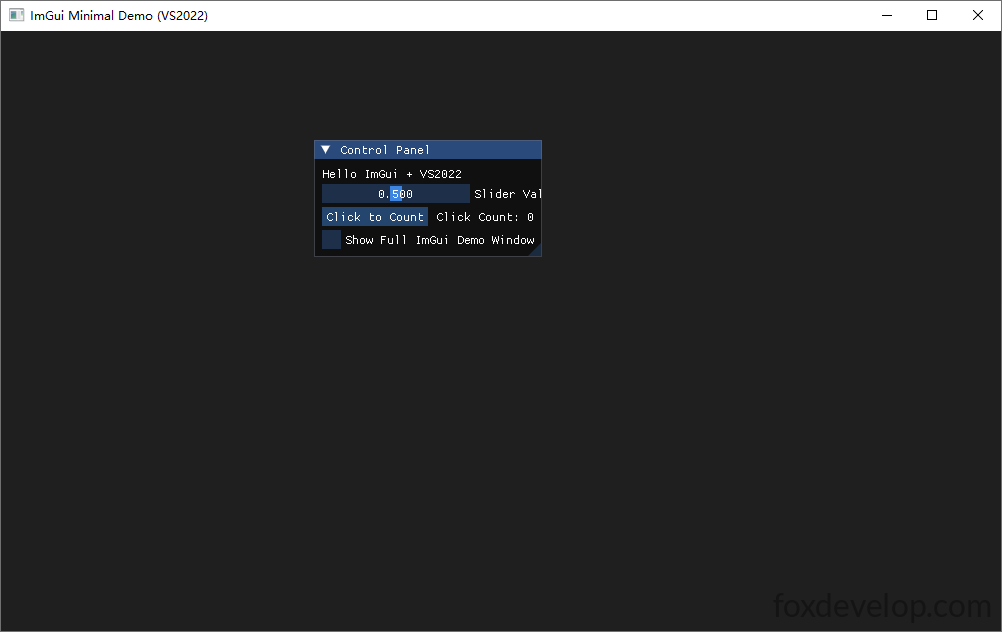
    GLFWwindow* window = glfwCreateWindow(1000, 600, "ImGui Minimal Demo (VS2022)", nullptr, nullptr);Code language: C++ (cpp)
We create a 1000×600 pixel window with the title “ImGui Minimal Demo (VS2022)”. The fourth parameter is nullptr for a parentless standalone window. The fifth parameter controls OpenGL context sharing between windows; nullptr disables sharing entirely.
The function returns a GLFWwindow* pointer as our window handle.
 if (!window)
    {
        glfwTerminate();
        return -1;
    }Code language: C++ (cpp)
The window pointer will be nullptr if window creation fails.
glfwTerminate() cleans up all global GLFW allocated resources.
We then return -1 to notify the operating system the program failed to launch correctly.
glfwMakeContextCurrent(window);Code language: C++ (cpp)Binds our new window as the active OpenGL render context; all subsequent OpenGL draw calls target this window only.
glfwSwapInterval(1);Code language: C++ (cpp)Enables vertical sync (VSync). A value of 1 locks frame rate to match your monitor’s refresh rate and eliminates screen tearing; set to 0 to disable VSync with unlimited FPS.
This setting is extremely important. Without VSync enabled, mismatches between GLFW rendering cycles and your display refresh rate will create visual tearing and distortion.
Global ImGui Initialization
IMGUI_CHECKVERSION(); // Validates header and backend version compatibility, triggers assertion on mismatch
ImGui::CreateContext(); // Creates ImGui global context storing all UI runtime state
ImGuiIO& io = ImGui::GetIO(); // Retrieves IO config object for input, fonts and global toggles
ImGui::StyleColorsDark(); // Applies ImGui’s official built-in dark theme styleCode language: C++ (cpp)
Bind GLFW+OpenGL Backends
ImGui_ImplGlfw_InitForOpenGL(window, true);Code language: C++ (cpp)Setting the second parameter to true lets ImGui capture all mouse and keyboard input automatically, blocking input from passing through to underlying application logic.
ImGui_ImplOpenGL3_Init(glsl_version);Code language: C++ (cpp)Initializes the OpenGL 3 render backend using our GLSL version string. It compiles vertex/fragment shaders and allocates GPU buffers for UI geometry.
float slider_value = 0.5f;    // Bound value for slider widget
int click_count = 0;          // Counter tracking button presses
bool show_full_demo = false;  // Flag to toggle visibility of ImGui’s official demo windowCode language: C++ (cpp)
These variables store persistent widget state values, read and updated every UI refresh frame.
Main Render Loop
This is the core program loop, running dozens to hundreds of times each second.
while (!glfwWindowShouldClose(window))Code language: C++ (cpp)The loop continues running until the window receives a close signal such as clicking the top-right X or pressing Alt+F4.
glfwPollEvents();Code language: C++ (cpp)Polls all pending OS window events: mouse movement, clicks, keyboard presses, window resizing, close requests and more.
ImGui_ImplOpenGL3_NewFrame();Code language: C++ (cpp)Performs pre-frame updates for OpenGL backend: resets render resources and clears draw buffers for the new frame.
ImGui_ImplGlfw_NewFrame();Code language: C++ (cpp)Prepares GLFW backend for new frame: reads real-time mouse coordinates, key states and window dimensions then feeds input data to ImGui IO.
ImGui::NewFrame();Code language: C++ (cpp)Starts layout calculation for a new UI frame and must run before all ImGui::xxx() widget calls. It clears all draw commands from the previous frame to collect new UI geometry data.
UI Widget Construction & State Logic
// Draw custom UI panel
ImGui::Begin("Control Panel");                // Initialize custom UI panel window
ImGui::Text("Hello ImGui + VS2022");          // Render static text on panel
ImGui::SliderFloat("Slider Value", &slider_value, 0.f, 1.f); // Float slider bound to numeric variable

if (ImGui::Button("Click to Count"))          // Create clickable button, returns true on full press+release
    click_count++;                            // Increase counter value on button click
ImGui::SameLine();                            // Force next widget to render on same horizontal row
ImGui::Text("Click Count: %d", click_count);  // Display live counter value on screen

ImGui::Checkbox("Show Full ImGui Demo Window", &show_full_demo); // Toggle checkbox for demo window visibility
ImGui::End();                                 // Finalize drawing for custom panel window

if (show_full_demo)
    ImGui::ShowDemoWindow(&show_full_demo);    // Render ImGui built-in full demo window if flag enabledCode language: C++ (cpp)
This section rebuilds the full UI layout on every loop iteration. It detects button clicks, increments the counter variable on trigger, and renders the updated counter value to the screen.
Final Render Pass
// Render ImGui draw data
ImGui::Render();                                        // Compile all UI geometry into GPU draw instructions
int width, height;
glfwGetFramebufferSize(window, &width, &height);        // Get actual pixel resolution of render surface
glViewport(0, 0, width, height);                       // Set OpenGL viewport to fill entire window
glClearColor(0.12f, 0.12f, 0.12f, 1.f);                // Set dark gray background clear color
glClear(GL_COLOR_BUFFER_BIT);                           // Clear framebuffer with background color
ImGui_ImplOpenGL3_RenderDrawData(ImGui::GetDrawData());// Send all ImGui UI geometry to GPU for rendering

glfwSwapBuffers(window);                                // Swap front/back buffers to display finished frameCode language: C++ (cpp)
Resource Cleanup On Exit
The following code runs after exiting the main loop to release all allocated program resources safely.
// Cleanup resources
ImGui_ImplOpenGL3_Shutdown();  // Free OpenGL backend resources including shaders and GPU vertex buffers
ImGui_ImplGlfw_Shutdown();     // Release GLFW window adapter backend memory
ImGui::DestroyContext();       // Destroy ImGui global context and free all UI memory
glfwDestroyWindow(window);     // Close GLFW window handle and destroy its render context
glfwTerminate();               // Fully unload GLFW library and release global window/input resources
return 0;                      // Return exit code 0 marking successful error-free program exitCode language: C++ (cpp)
Cleanup functions run in reverse order of initialization to prevent memory leaks and leftover graphics resources.
That concludes our line-by-line breakdown of the ImGui demo from the previous post. Leave a comment below if any section remains unclear to you.