1. Dart’s Three Built-in Collection Types
Dart ships with three native collection types: List, Set, and Map.
Generic type constraints can be applied to restrict the data types stored inside each collection via Generics.
| Collection Type | Core Features | Literal Syntax |
|---|---|---|
| List | Ordered, allows duplicate entries, index-based access | [] |
| Set | Unordered, unique values only, no index access | {} (explicit generic annotation required to create a Set) |
| Map | Key-value storage, unique keys, duplicate values permitted | {key: value} |
2. List (Ordered Arrays)
1. Basic Definition & Type Inference
- Arrays in Dart are implemented as
Listobjects, instantiated with the[]literal syntax; - Types are inferred automatically. For example:
var list = [1,2,3]resolves toList<int>; inserting non-integer values will throw a compile error; - Trailing commas are fully supported without breaking syntax, which reduces copy-paste bugs:
var list = ['Car', 'Boat', 'Plane',];
2. Core Operations
- Index rules: Indexes start at 0; the last element’s index is
list.length - 1; - Read / update elements:
list[index],list[index] = newValue; - Retrieve total element count:
.lengthproperty;
Example
void main() {
	var list = [1,2,3];
	print(list.length);// Prints total element count: 3
	print(list[1]);// Outputs 2
	list[1] = 9; // Update the second element to 9
	print(list[1]);// Outputs updated value: 9
}Code language: Dart (dart)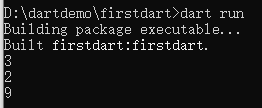
3. Constant Lists (Compile-Time Immutable)
Prefix the literal with const to create an immutable list; elements cannot be added, removed or modified at runtime:
void main() {
	var constantList = const [1,2,3];
	constantList[1] = 100; // Throws compile error
}Code language: Dart (dart)
D:\dartdemo\firstdart>dart run
Building package executable...
Built firstdart:firstdart.
Unhandled exception:
Unsupported operation: Cannot modify an unmodifiable list
#0 UnmodifiableListMixin.[]= (dart:_internal/list.dart:89:5)
#1 main (file:///D:/dartdemo/firstdart/bin/firstdart.dart:4:14)
#2 _delayEntrypointInvocation.<anonymous closure> (dart:isolate-patch/isolate_patch.dart:314:19)
#3 _RawReceivePort._handleMessage (dart:isolate-patch/isolate_patch.dart:193:12)Code language: PHP (php)3. Set Collections
Unordered collection with unique values only
1. Core Set Characteristics
- Unordered storage: No fixed index positions; values cannot be read or updated via bracket indexing
[index] - Automatic value uniqueness: Duplicate entries are silently discarded; no runtime error is thrown when adding duplicates
- Literal syntax: Curly braces
{} - Generic type restrictions: Lock storage to a single data type; inserting mismatched types triggers compile or runtime errors
Differentiating empty Set vs empty Map (Common Pitfall)
Bare {} defaults to a Map. To create an empty Set you must explicitly declare the generic type parameter.
void main() {
	// Empty Set<String>
	var names = <String>{};
	Set<String> names2 = {}; // Equivalent declaration

	// No generic annotation; Dart infers Map<dynamic, dynamic>
	var names3 = {};
}Code language: Dart (dart)
Type Inference Rules
void main() {
	// Automatically inferred as Set<String>
	var halogens = {'dog', 'cat', 'horse'};

	// Automatically inferred as Set<int>
	var nums = {1, 2, 6, 2}; // Duplicate value 2 is deduplicated, final set: {1,2,6}

	// Mixed value types inferred as Set<Object> (not recommended, disables strict type checking)
	var mix = {1, "apple"};
}Code language: JavaScript (javascript)
Once the type is inferred, inserting values of a different type will throw an error.
void main() {
  // All literal values are strings, inferred as Set<String>
  var animals = {'dog'};
  print(animals.runtimeType); // _CompactLinkedHashSet<String>

  // Adding matching string values works with no errors
  animals.add('cat');
  animals.add('pig');
  print(animals); // {dog, cat, pig}

  // Error: Cannot pass int to add(), which expects a String argument
  animals.add(1);
}Code language: Dart (dart)
2. Add, Remove & Length
- Add single element:
.add(); - Bulk add multiple elements:
.addAll(); - Get total element count:
.length;
var elements = <String>{};
elements.add('fluorine');
elements.addAll({'chlorine', 'bromine'});
print(elements.length); //3Code language: PHP (php)
3. Constant Sets
Prefix the literal with const to create a read-only Set; no new elements can be added or removed:
final constantSet = const {'fluorine', 'chlorine'};
// constantSet.add('helium'); // Throws errorCode language: PHP (php)
4. Map (Key-Value Mappings)
1. Base Features
- Stores paired
Key-Valuedata entries; - Keys are globally unique, duplicate values are allowed;
- Keys and Values support any object type;
- Literal format:
{key: value}; - Automatic type inference:
void main() {
	var gifts = {'first': 'partridge'}; // Inferred Map<String, String>

	var nobleGases = {2: 'helium'}; // Inferred Map<int, String>
}Code language: Dart (dart)
2. Two Map Initialization Styles
- Literal initialization
var gifts = {'first': 'partridge'}; Code language: Dart (dart)- Map constructor syntax (the
newkeyword is optional)
// Constructor initialization
var gifts = Map<String, String>();
gifts['first'] = 'partridge';Code language: JavaScript (javascript)
3. Insert, Lookup & Length
- Add or overwrite key-value pairs:
map[key] = value; - Retrieve value by Key:
map[key]; returnsnullif the key does not exist; - Get total key-value entry count:
.length;
var gifts = {'first': 'partridge'};
gifts['fourth'] = 'calling birds'; // Insert new entry
print(gifts['first']); // Lookup value
print(gifts['fifth']);// Lookup non-existent key
print(gifts.length); // Get total entry count Code language: PHP (php)
4. Constant Maps
Prefix the literal with const to lock the map; key-value pairs cannot be modified:
final constantMap = const {2: 'helium', 10: 'neon'};
// constantMap[2] = 'Helium'; // Throws errorCode language: Dart (dart)
5. Enhanced Collection Literal Syntax
Collection literals support multiple special syntax forms, split into two categories: base leaf elements and control flow elements, which simplify building complex collections inline.
- Base leaf elements: Single expressions, Map key-value pairs, null-safe optional entries
- Control flow elements: Spread operators, conditional if blocks, for loops, and nested combinations
1. Standard Expression Elements
The most basic syntax: write raw expressions directly; their evaluated results are inserted into the collection. In the sample below, the second element is calculated via 2 * 3, producing the final list [1, 6, “text”].
void main() {
	var list = [1, 2 * 3, 'text'];
	print(list); //[1, 6, text]
}Code language: PHP (php)
2. Key-Value Elements
Exclusive to Map literals, formatted as keyExpression : valueExpression. The example below uses dynamic expressions to generate both the first entry’s key and value.
void main() {
	var map = {1+1: 3*8, 'name': 'apple'};
	print(map); //{2: 24, name: apple}
}Code language: Dart (dart)
3. Null-Safe Optional Elements (Dart ≥3.8)
Syntax: ?expression. The entry is only inserted if the expression evaluates to non-null; null values are silently discarded.
Usage inside List: variable a is null so it is omitted from the final list, no runtime error occurs.
int? a = null;
int? b = 3;
var items = [1, ?a, ?b, 5]; // [1, 3, 5]Code language: JavaScript (javascript)
Usage inside Map (both keys and values support the ? operator)
String? k = null;
int? v = null;
var m = {?k: ?v}; // If either key or value is null, the entire pair is dropped
Code language: JavaScript (javascript)
4. Spread Elements
① Standard Spread ...
Flattens all items from an iterable collection and inserts them inline; cannot spread null collections
var a = [1,2,3];
var items = [0, ...a, 4]; // [0,1,2,3,4]Code language: JavaScript (javascript)
② Null-Safe Spread ...?
Safely handles nullable collections: if the source collection is null, the spread is ignored with no error;
If the collection itself is non-null but holds null values internally, those null entries remain preserved.
List<int>? a = null;
var b = [1, null, 3];
var items = [0, ...?a, ...?b, 4]; // [0, 1, null, 3, 4]Code language: PHP (php)
Coding convention: Always use
...?for nullable iterables, otherwise a compile error will be thrown.
5. If Conditional Elements
Inline if branches directly inside collection literals; entries are only injected when the condition evaluates true. Supports boolean checks, if-case pattern matching, and else clauses.
Basic Boolean Conditions
void main() {
	bool flag = true;
    var list = [0, if(flag) 1 else 99, 2];
	print(list); //[0, 1, 2]
}Code language: Dart (dart)
if-case Pattern Matching (Type & List Destructuring)
void main() {
	Object data = 123;
	var info = [
	  if(data case int i) 'Number: $i',
	  if(data case String s) 'Text: $s'
	];
	print(info); //['Number: 123']
}Code language: Dart (dart)
Since data is an integer, only the “Number: 123” entry is added; the text branch is skipped entirely.
6. For Loop Elements
Inline for loops inside collection literals to generate multiple entries dynamically; both for-in and standard three-segment for loops are supported.
var nums = [2,3,4];

// for-in iteration
var list1 = [1, for(var n in nums) n*n, 7]; // [1,4,9,16,7]

// Traditional three-part for loop
var list2 = [1, for(var x=5; x>2; x--) x, 7]; // [1,5,4,3,7]Code language: JavaScript (javascript)
7. Nested Control Flow
if statements, for loops, and spread operators can be nested arbitrarily deep, offering functionality equivalent to list comprehensions found in other languages.
Example: Filter to retain only even numbers
var numbers = [1,2,3,4,5,6];
var items = [
  0,
  for(var n in numbers)
    if(n.isEven) n,
  8
]; // [0,2,4,6,8]Code language: JavaScript (javascript)
Example: Nested for + if + spread operator combination
void main() {
	var ys = [1,2,3];
	var nest = [
	  ...[
		for(var x=0;x<2;x++)
		  for(var y in ys)
			if(x<y) x+y*10
	  ]
	];
	print(nest); //[10, 20, 30, 21, 31]
}Code language: Dart (dart)