Dart is a programming language created by Google, much like Go — both languages are led and developed in-house by Google.
It was unveiled by Google back in 2011, built by core engineers from the V8 engine team: Lars Bak and Kasper Lund.
Originally designed to replace JavaScript for web development, it later became the sole language powering the Flutter framework, with a primary focus on cross-platform client development (mobile, web, desktop).
Google relies heavily on Dart for many of its core internal services, including YouTube, Google Cloud Platform, and its underlying infrastructure. It boasts a massive, thriving developer community that exists separately from Flutter’s client-side ecosystem.
The biggest advantage? You can write one single codebase and ship fully functional apps for Android, iOS, macOS, Linux, Windows, and more.
Core Positioning
Dart is a cross-platform language optimized for client-side development. It’s built to deliver a streamlined, efficient multi-platform development workflow paired with flexible runtimes to support application frameworks. It serves as the foundational layer for Flutter, and ships native tooling out of the box including auto-formatting, static analysis, and unit testing. You can compile and deploy Dart projects to web, mobile, desktop, and other target platforms.
Technical Highlights
Hot reload is fully supported during active development.
For production builds, it outputs polished, high-performance applications for every supported platform.
Type Safety
- Sound static typing: Strict type matching is enforced, yet type inference lets you skip redundant type annotations when possible;
- Dynamic typing via the
dynamickeyword, paired with runtime checks to accommodate flexible, dynamic coding use cases.
Sound Null Safety
Variables cannot hold null values by default; nullability must be explicitly declared. Static analysis eliminates null pointer crashes at runtime, and non-null variables are guaranteed to never contain null throughout execution.
It comes packed with built-in syntax features including core libraries, asynchronous calls, nullable/non-null type systems, arrow functions, generators, streams, getters, and more.
Extensive Dart Standard Library
- dart:core: Mandatory for all Dart programs; supplies fundamental built-in types, collections, and universal core utilities
- dart:collection: Extended collection toolkit featuring queues, linked lists, hash maps, binary trees, and other advanced containers
- dart:convert: Data encoding and decoding utilities for seamless conversion between JSON, UTF-8, and other standard formats
- dart:math: Predefined mathematical constants, calculation helpers, and random number generators
- dart:async: Foundation for asynchronous programming, housing core async primitives like Future and Stream
- dart:typed_data: Efficient fixed-size binary arrays (e.g., 8-bit unsigned integers) and SIMD numeric types
- dart:io: Exclusively for non-web targets; exposes file system, socket, HTTP, and other input/output functionality
- dart:ffi: C-style foreign function interface to enable bidirectional interoperability with native C code
- dart:isolate: Concurrent isolated execution units similar to threads, with no shared memory — communication happens solely via message passing
- dart:js_interop / package:web: Web-only libraries for manipulating HTML elements, browser DOM, and bidirectional JavaScript interop
Beyond these core built-in libraries, Google officially maintains a wide suite of supporting packages such as characters, intl, http, crypto, and markdown. Thousands more third-party packages are published by the community, adding support for XML parsing, Windows system integration, SQLite databases, data compression, and countless other features.
Supported Dart Runtime Targets
Dart runs across multiple platforms thanks to its multi-layered compilation pipeline:
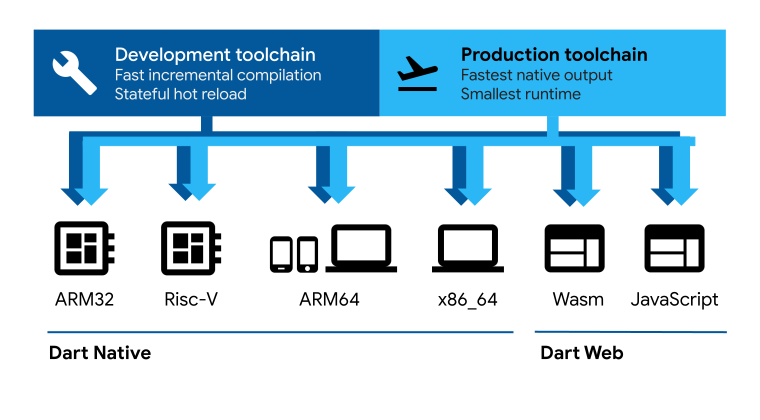
1. Native Platforms (Mobile / Desktop)
Two complementary compilation pipelines ship natively: a Dart virtual machine with just-in-time (JIT) compilation, plus an ahead-of-time (AOT) compiler that outputs optimized machine code.
2. Web Platform
Separate compilation workflows exist for development and production, capable of transpiling Dart into JavaScript or WebAssembly.
Flutter is the leading cross-platform UI toolkit built entirely on Dart. It comes with a complete set of developer tools and pre-built UI widgets to build apps for iOS, Android, macOS, Windows, Linux, and the web.
Dart Native Compilation (JIT + AOT)
- Development builds (JIT): Incremental compilation via the VM enables hot reload, paired with real-time performance profiling and full debugging utilities for ultra-fast iteration cycles;
- Production releases (AOT): Code compiles directly to ARM/x64 native machine code for consistent, fast app startup times;
- The runtime includes robust memory management with generational garbage collection and fast object allocation, while fully enforcing Dart’s sound type safety rules at all times.
Dart Web Compilation (JS / WasmGC)
Dart source can be transpiled to JavaScript to run inside browsers powered by engines like Chrome’s V8, or alternatively compiled to WebAssembly:
- Development compile mode: Incremental JavaScript compiler supporting hot reload for quick debugging and iteration;
- Production JavaScript compile: Heavy optimization, minification, and dead-code elimination produce lightweight, performant JavaScript bundles;
- WasmGC production compile: Outputs high-performance garbage-collected WebAssembly binaries for drastically improved runtime speeds.